From Cluttered to Clean: Workspace Transformation with Retractable Monitors
Nobody walks into a meeting room and thinks:
“Wow, I love how that screen just sits there taking up space.”
They don’t. And yet — that’s still the default in most offices, most homes, most conference rooms around the world.
There’s a better way. And it’s been quietly transforming boardrooms, hotel suites, and home offices for years.
It’s called a retractable monitor. And once you see it in action, you can’t unsee it.
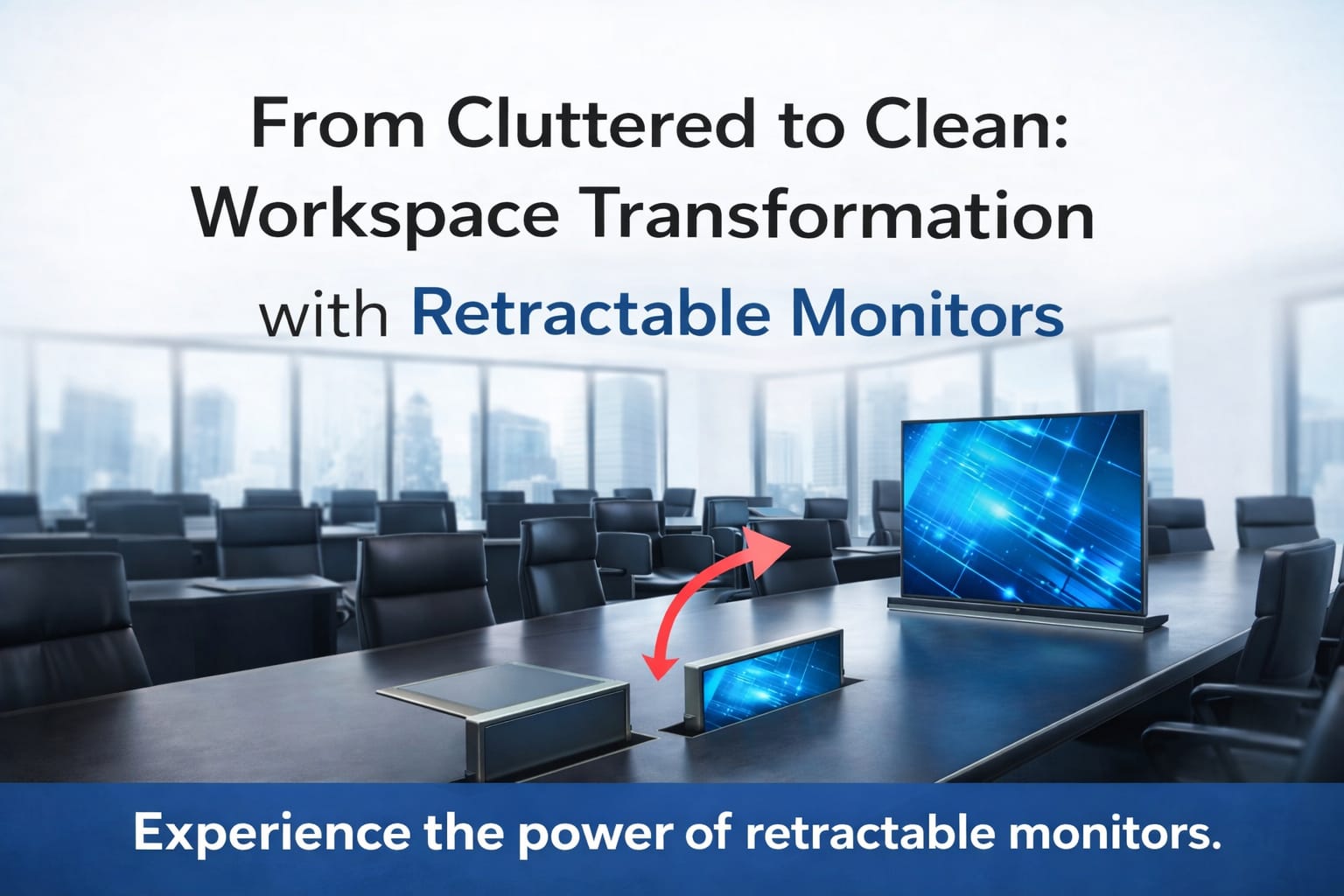
We just completed a retractable monitor installation in a conference hall.
And the moment the client saw the monitors rise from the table on first power-up — that reaction said everything.
Here’s a behind-the-scenes look at what we built, how we engineered it, and why this technology is changing the way conference spaces are designed.
The Brief
The client needed a conference hall that could function as a high-end presentation space — but without the permanent visual weight of fixed screens dominating the room.
The requirement was clear: full-size displays available on demand, completely out of sight when not in use, and operable without any manual handling by the end user.
Our answer: motorized retractable monitors integrated directly into the conference table.
What We Installed
We deployed a set of motorized pop-up monitor lifts housing professional-grade displays, recessed flush into the conference table surface.
Key technical specifications of the build:
- Smooth automatic pop-up screens
The monitors rise and hide quietly at the press of a button. They’re built to work reliably for a very long time. - Perfectly flat table surface
When the screens go down, the table becomes completely flat — you can’t even tell anything is installed inside. - Neat and protected cables
All the wires are safely organized inside the system so nothing gets tangled, damaged, or visible on the table. - One-touch control
A single control panel lets you raise or lower all the screens together or one at a time. You can also start the full meeting setup with one tap.
“The hardest part of a retractable install isn’t the lift — it’s the integration. Every cable, every connector, every signal path has to survive years of daily mechanical movement.”

The Engineering Challenge
Retractable monitor installs look simple on the surface. The engineering underneath is anything but.
Cable routing through moving systems is the most failure-prone element of any motorized installation. Standard AV cabling is not designed for continuous flexing. We specified purpose-built flexible signal cables and used structured drag chains to control the bend radius through every cycle.
Limit switch calibration is critical. The actuator must stop precisely at the fully-extended and fully-retracted positions on every single operation — not approximately, precisely. Drift in these settings over time causes mechanical stress and display damage. We set and verified both limits under load.
Table integration required close coordination with the furniture installer. The housing cutouts, cable routing channels, and control panel recesses all had to be specified before the table was fabricated — retrofitting these is significantly more complex and costly.
Noise floor was a hard client requirement. A conference hall that rattles every time a screen appears defeats the purpose. We selected actuators specifically rated for this operation, tested against the room’s ambient acoustic level.
The Automation Layer
The hardware is only half the story. What makes this installation genuinely impressive is the control logic sitting above it.
The monitors are integrated into the room’s AV control system. A single button press on the touch panel triggers a sequenced automation routine:
- Step 1 — Monitors rise to fully extended position (approximately 8 seconds from flush to locked-out).
- Step 2 — AV signal routing activates, connecting the presenter’s input source to the displays.
- Step 3 — Display power-on sequence completes, screens come live with source signal ready.
- Step 4 — Room lighting adjusts to presentation preset via the integrated lighting control.
Retraction runs the sequence in reverse. One button. The room resets. The table is clear.
“Automation isn’t a luxury feature here — it’s what makes the technology usable. A system that requires five manual steps will be bypassed. A system that works in one tap will be used every time.”
The Result
The installed conference hall now operates with a level of AV polish that was simply not achievable with fixed display hardware.
The client’s facilities team can run a full presentation setup in under 10 seconds from a cold room. The table remains a clean, professional surface for meetings that don’t require display content. And the monitors — when they do appear — create a genuinely impressive first impression for visiting clients and stakeholders.
That first power-up reaction from the client? We’ll take it.

Working on a Similar Project?
If you’re specifying a conference space and want to understand whether retractable monitor are the right fit — the answer depends heavily on the table design, the AV control architecture, and your acceptable maintenance profile.
PC-e-Systems Pvt Ltd happy to talk through the technical considerations before you commit to a solution.
Drop a comment, send a message, or tag someone who needs to see this kind of build. 👇